Rift Walker Spark Points System and Quest Progress Bar
I've recently had an idea about a system that could be used to replace desperate aspects of Rift Walker. This will make the game a little bit more crunchy but purely in a narrative sense and give the players a marking of progress like you would in a video game. I believe this system will need a little bit of work to iron out some of the finer details but I believe it will be a strong addition to the next version of Rift Walker.
Uses and Narrative Flavour
This system will combine the recovery and fate systems. It will interact with critical wounds, the focus action, montages, and peril point systems. This has two functions: one to track the progress through a quest and to give players more flexibility in how they can accumulate resources for them to spend however they wish. They are inextricably linked. The adventure will start by having a set number of dice that is the required progress to complete the adventure. This is based on a formula of difficulty set by the Rift Master as players complete objectives through narrative encounters/scenes, and montage scenes. This is the Quest Progress Bar. They will mark progress on these dice, which will give them spark dice that they can use to power specific abilities. These are Spark Points. This represents the connection that these characters have to the magic of the rifts. They are Rift Walkers. The spark inside them that keeps them going through drive and momentum it powers their willpower and their endurance. That is where it is stored. Any that are left over before the detailed encounter at the end will become peril points that the Rift Master can use against the Rift Walkers. Then that scene will have its own dice that will be affected like regular hit points in a combat encounter. A quick note on that not completing a montage or narrative encounter, isn’t railroading by the RM. It represents bypassing a potential clue not unlocked a reward untaken a problem, not dealt with. This is then handled as peril points that can be factored in however the RM wants, rather than tying specific complications to specific unchecked encounters. It would probably be within the RM’s best interest to put a timer in place for certain sorts of adventures that have urgency, but not have them for sandbox style adventures.
Ways to mark progress on the quest progress bar include:
Completing narrative goals
Making your way through the montage test
Gaining additional successes from checks.
These will become spark points that Rift Walkers can spend other ways. For Rift Walkers to accumulate spark points include:
Completing a point on the Quest Progress bar (all)
Having a scene where you utilise your flaw
Having a scene where you utilise your personality
Suffering a critical wound
Taking the focus action
These points will then go into the Endurance and Will Power pools of Rift Walkers for spending on those pools. Ways to spend spark points include:
1:1 spending to use as recovery to your pools after you take damage (up to your max in that pool - from related Endurance/Will Power Pools)
1:1 spend on gaining additional modifiers to checks (from related Endurance/Will Power Pools)
3 to be used as a re-roll, formally known as a fate point or bonded fate point (from any Endurance/Will Power Pools)
4 to be used to get a power die back (from any Endurance/Will Power Pools)
5 to be used to recover a critical wound (from related Endurance/Will Power Pools)
This is used to encourage Rift Walkers acting as their character would. It encourages engagement with the quest, as players can literally see the progress as it goes. It keeps the session pacing at the front of mind, keeping in mind the length of the session. The reason for this is that at any time, should it be getting late in the session and the Rift Master is thinking about pacing, they can activate the detailed encounter such as the raiders busting through the castle wall and engaging. This also allows the resources in your quest to not just start high and be on the basis of attrition going down but also give you something that as you complete your quest will mark up, showing that your direct heroic actions create these points. This also gives flexibility to the player as they can choose to spend them on fate points, power dice, recovery, or helping rolls. This also gives flexibility to the generalist class as when they focus, they can keep this as a resource, not just make it so that they are always good at their next possible roll.
Formula
The formula for the progress bar, is in line with the legend difficulty. (This will require further play testing to get right).
RW total + Montage total (typically RW total +/-1) + Narrative Encounters total (typically difficulty) + Difficulty (extra)
This also affects the number of:
Total narrative encounters
Starting peril for the Rift Master
Total Mooks in Detailed Encounter
Total for pools of Elite foes
Total for Boss 2 biggest pools and split total for other 2 pools
Total dice for environmental effects
Example Quest - Face Gold Flame
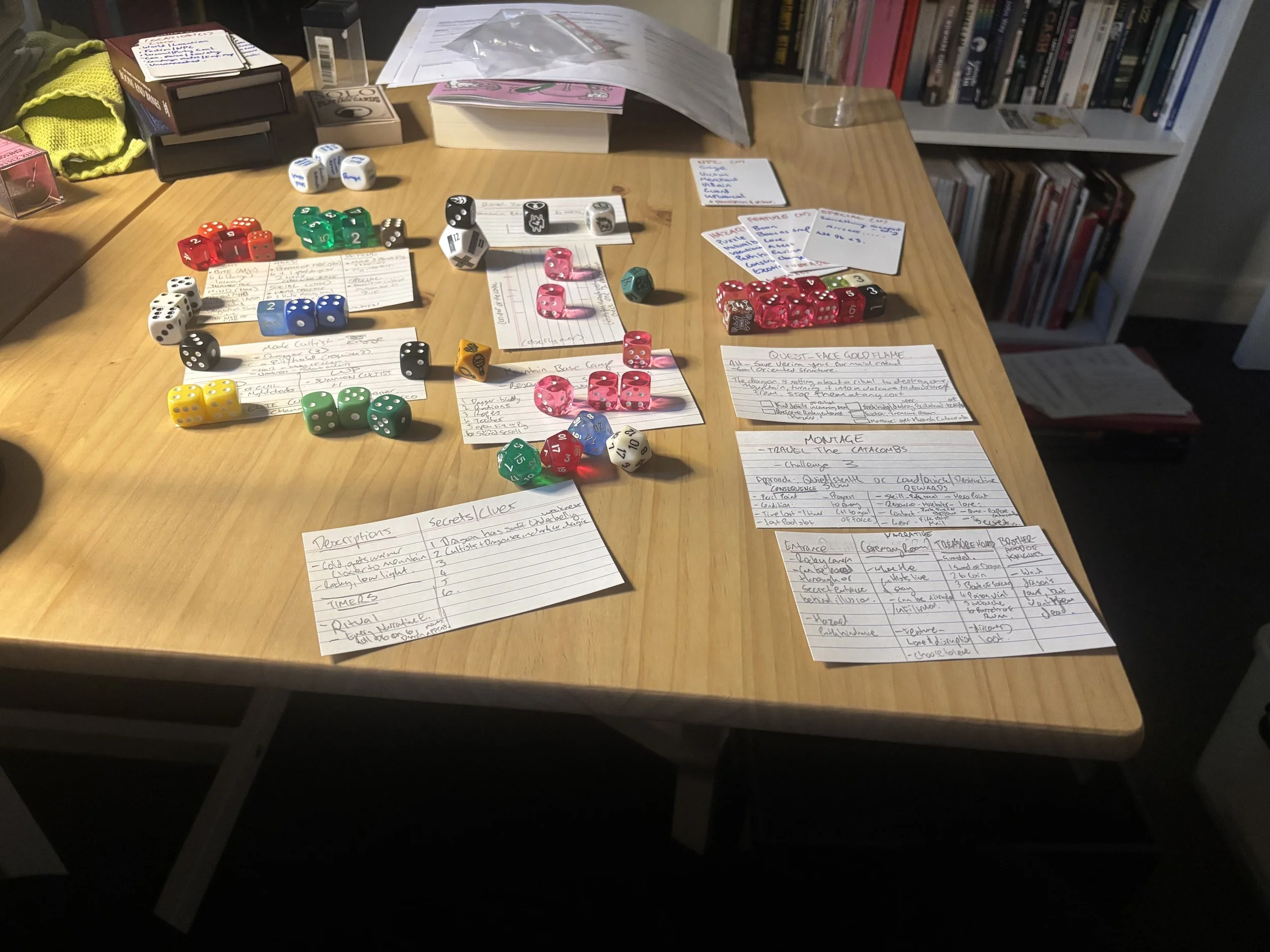
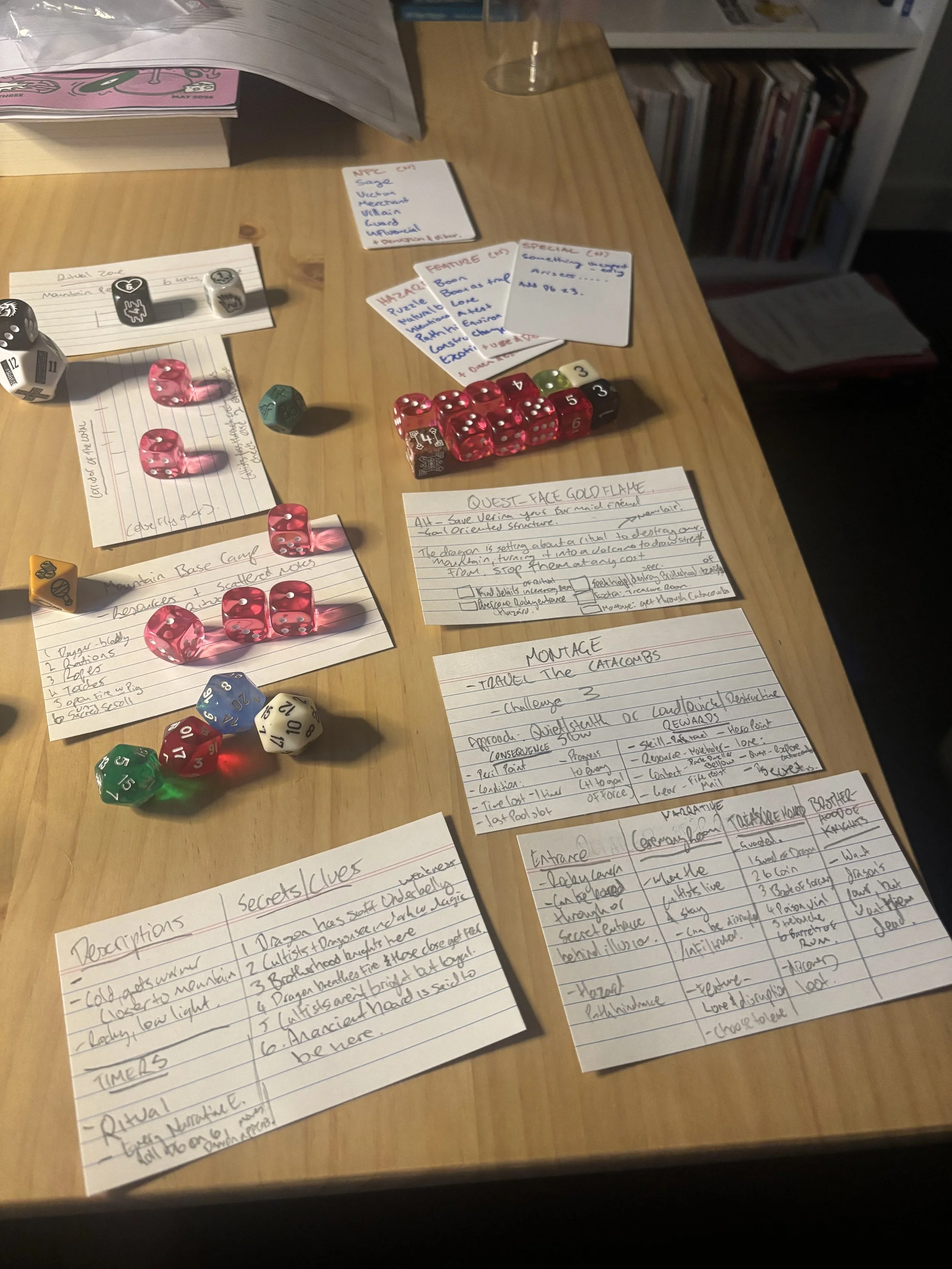
In this example quest, the Rift Master has determined that the difficulty for the session will be 3. Having 4 Rift Walkers in the session means that there are 13 progress dice required to be completed. This will also mean that the montage test will require three successes to pass. In this quest, the dragon Gold Flame is setting about to create a new layer by doing a ritual to destroy the mountain; this will turn it into an active volcano where they can draw strength from. The Rift Walkers must stop them at any cost. The alternate objective is to save Verina, their friend, who has been abducted by Gold Flame. This is a goal-oriented structure from my quest structures list. To prepare for this, I designed four areas for them to explore plus a montage encounter. The goals that need to be marked off in this find the details of the ritual, overcome the entrance, and gain a way into the mountain. Seek help from any forces that may be there and an extra bonus.
The first narrative encounter is seeking entrance to a rocky cabin. It seems like the mountain doesn't have any entrance immediately, but through careful exploration or the use of magic, they can find that there is a secret illusion if they want to sneak in or they can bust through the rocky outcrop by finding a place where there's a gap in the rock; this will be a loud approach. You can tell from this encounter that there are parts and choices baked into the design. This is a hazard, hindrance encounter from my list.
Then, depending on the way that they wish to travel, they can either go towards an area where they hear a sound or they can notice that there's an underground cabin that they can explore from here. If they go towards the sound, they find a room where the known force of the Brotherhood of Knights has slain a bunch of cultists and then is bickering about their approach that they wish to take in the mountain. Depending on how the Rift Walkers have interacted with them before, they can either recruit them in their Crusade or they may need to fight them. This is a special encounter from my list.
Next, if they go back underneath, they can travel through the catacombs, which is a montage encounter. This requires three successes from the group. Any successes will be subtracted from the quest progress bar. Then, any additional successes will incur a choice of reward. If they do not meet the required number of successes, they will need to select consequences.
Travelling deeper into the mountain, they come across a room full of cultists. They have been resting and recuperating in here, ready for the ritual. This could be a time that they could try to blend in or they could go about the loud route and take them all down. There's plenty of opportunity for learning secrets included in here. This is a feature lore encounter from the list.
This is an optional encounter. Where, if the Rift Walkers play their cards right, they find out about a treasure board that they can receive loot from. A discovery encounter that has a hidden gate entrance.
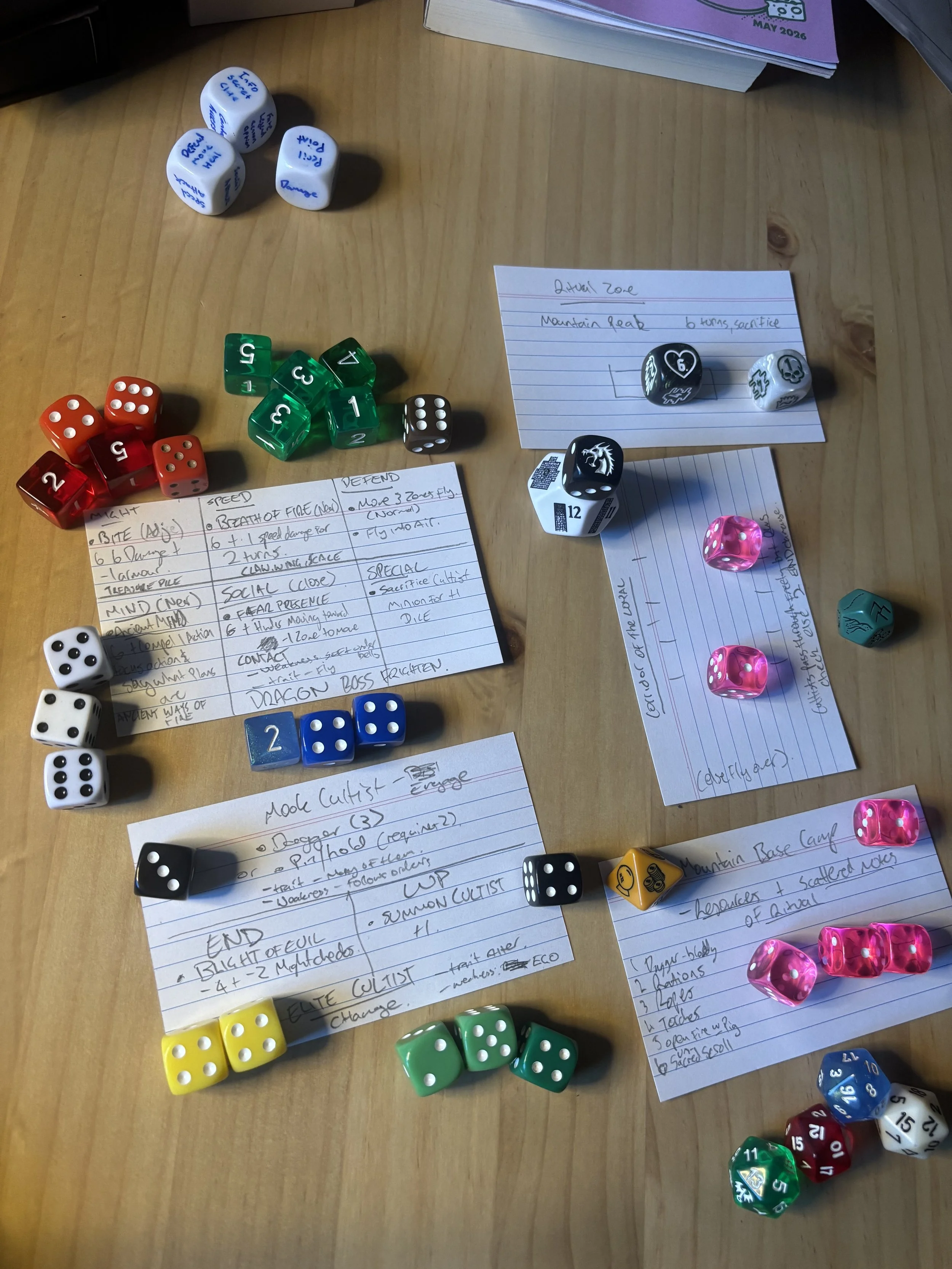
The final scene is the detailed encounter against Gold Flame. The three zones for this encounter will be the mountain base camp where they can find resources and scattered notes. They will face off against some cult minions here. The next zone is the corridor of the Loyal. This is an area where there are these flaming coals and tight corridor that they need to pass through up the mountain else. It be too slippery to go around. Any of the cultists can freely move through here but the Rift Walkers will need to find a way. Finally, there is the ritual zone where an elite cult is sacrificing their friend and where the dragon flies to destroy them. In this encounter any of the uncompleted progress dice will become parallel points for the Rift Master to use. It will transition over to the normal dice for each monster or issue that they need to deal with as kind of progress and hit points for the encounter.
A note on Foe Damage and Conditions
I keep getting questions and thinking a lot about Foe damage. In the example of this encounter, the dragon has 4 pools linked to attacks:
Might - linked to the bite attack
Speed - linked to the flaming breath
Mind - linked to the ancient mind force
Social - linked to the fear and intimidating presence
Each of these can be brought down through damage to their regular pools. For example, people targeting the dragon with speed attack attacks are going to try to remove the ability to do its breath weapon because it's so powerful. Once those pools have been emptied, they will no longer be able to use that attack. There are two other attacks that might come up when randomly rolling for the dragon’s attacks. That is a defend move where the dragon flies up into the air; and a special move with a sacrifice of a cultist to gain a dice back. These ones won't have pools that can be damaged but could still be affected by conditions, so for example, finding a way to pin the dragon down will remove its ability to fly. Alternatively, removing all of the cultists means that the dragon can no longer sacrifice them. Those are the ways to permanently remove the attacks from the boss monster.
To temporarily disable and attack Rift Walkers, may use conditions to hinder specific attacks. That will be the need to be a skill check or a power dice usage. That will be spent on a dice for dice basis temporarily rather than the value on the dice to permanently remove them. It is also important to remember that the two pools that are brought down on the creature first will result in the rewards that are available to them, so for example, if the mind pool is brought down, they will be able to learn the ancient ways of fire skill from the Dragon. Other examples might include access to the treasure pile, speed, being access to its resources of clause wings and scales, and social making them a contact. This facilitates the choice in approach for the Rift Walkers.
In the example of the minions, they won't provide anything meaningful in terms of rewards as they only have one attack and take one damage before they are brought down. The elite cultist has two attacks and endurance and a willpower one that, depending on approach, Rift Walkers could either role might or speed for. If the insurance one comes up, only one of these two pools will need to be brought down, and that will result in either the elite having been killed or morale being taken down. Weaknesses and traits of the cultists, elite, and dragon can be found as secrets throughout the adventure.
It is also worth noting that the effectiveness of monster attacks directly relates to the amount of damage that they have taken. Like a character in the game is less likely to succeed at a check with less dice in their pool; a monster has less options and flexibility with their attacks. As each attack has a default range adjacent, close, near or far; dice beyond the first in that pool can be used to change the range of the ability; going up and down range bands for each dice spent. Foes can also spend dice to make checks harder on a one for one basis with those it is attacking. They can also spend dice to target multiple creatures in the range bands they have unlocked. This means the dragons fire breath attack starting with 5 dice and being near range, could affect four characters in that band or three if it needed to hit somebody that was close or far. The less dice they have the less options they have with that attack and so the weaker it is. As discussed before when it comes to rewards this gives more choice and incentives to players. Even though there are 5 dice to knock out in the breath weapon attack making it harder than others, they might really want to take the resources like the scales from the dragon for some other purpose.