Solo Role-Playing Crown and Skull
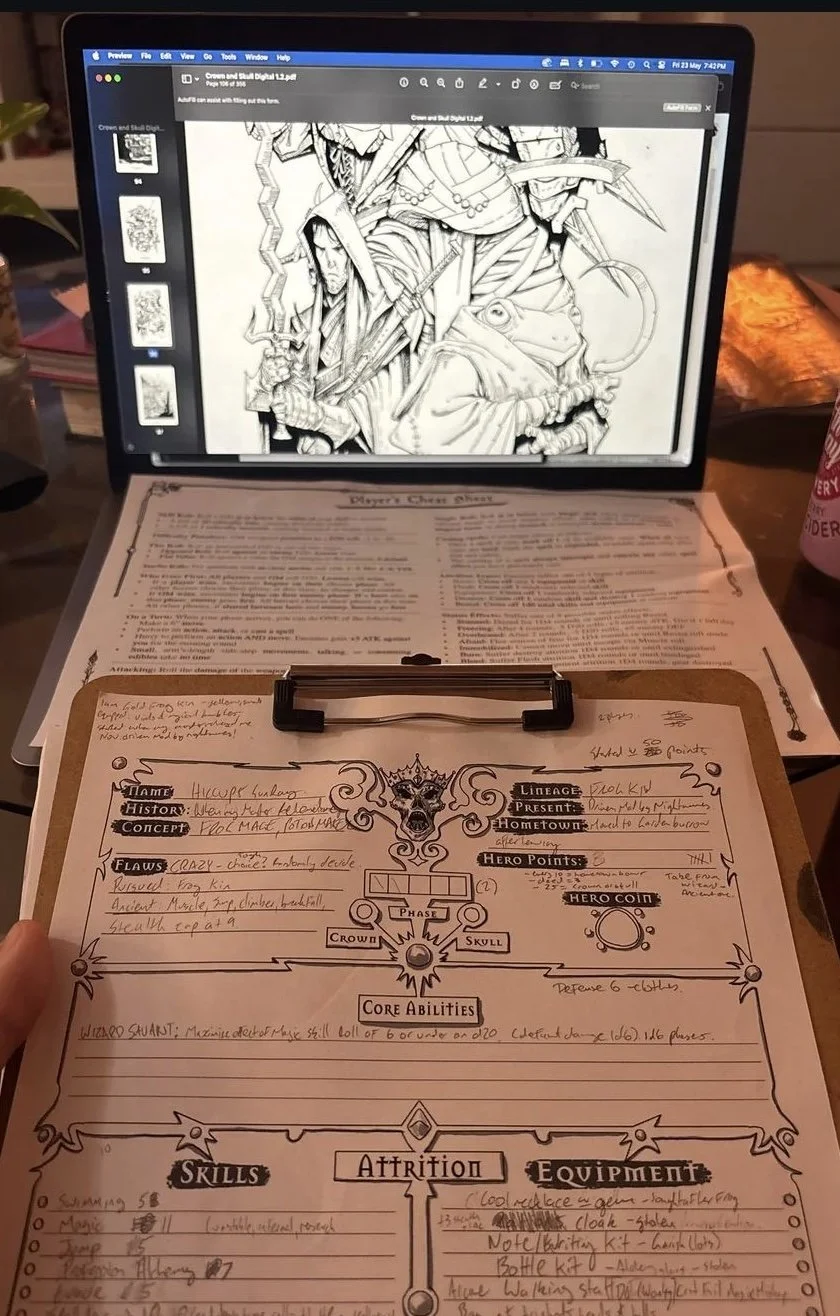
My setup for Crown and Skull solo.
Over this last week I have been testing out the solo role-playing capabilities of Rune Hammer’s newest tabletop, role-playing game Crown and Skull. Using the stuff found in the core book (of which I’ve read the second volume as well being fantastic), I built a character. Through a series of random tables, I rolled up a frog kin wizard style character. Hiccups as he was known, had a lot of interesting role-playing connections such as flaws that allowed him to be pursued, ancient and crazy to give me a basis on which to role-play from. It was great to be able to pick a core ability of which I picked Wizard Savant, and limit that to just the one so the players don’t feel overwhelmed. I have found building characters in this system to be a little confusing at times, but generally quite straightforward. Having a kind of free point base in which to spend on abilities can seem overwhelming, but not in the same way that game such as Pathfinder feel overwhelming. Those games require you to pick from a very large list of abilities here that simple roll tables. In Crown and Skull you can even make up stuff your own by creating flaws and perks for gear and spells. Actually, on that note, custom spells in this game are amazingly deep in complex for those who like complex design. It could be quite straightforward for those that don’t picking too many choices. Using spells in this really kind of arcane manner where they can be tweaked with flaws and perks was really powerful. I also love that by default, they are quite weak until they are built up. The base spells only have a single use, which again would be fine in a group setting, but I found a unique challenge playing with one character. This would be something I would love to delve into more. Things like a Hometown and what they’re up to at the moment really helps set the scene for a character. It was a great little task to be able to find the most effective way to spend my points without it being overwhelming. I really enjoyed overall the system of building characters.
It has a series of unique mechanics that allow to be easily role-played so solo. These include intuitive things like GM tools, including monsters that role-play themselves by having tactics tables phases, and a short description. The player facing mechanics of defending or evading against things and rolling for skills under your D20 value really encourage this sort of player first mentality. This was really easy for me to solo role-play in terms of using equipment. It was fun to be able to pick and choose whatever I wanted. I also really liked that skills and equipment are your hit points they add a real sense of danger and this almost death spiral to combat which make you especially as a solo role player want to avoid combat. On the note of combat, there were some abilities that I think I would’ve tackled differently, had I been the GM for a group because this game really encourages a sort of “have a conversation with your game master” approach. For some of the ways that things are worded in a slightly open-ended way this is great in a group setting, but when I’m already playing solo trying to act as the GM and the player, I found this a little overwhelming at times. But, to be honest this applies to a lot of different games so I won’t hold it against Rune Hammer in the creation of this.
I’ve been a fan of Brandon and all of his personas over the years for the various games that they’ve created things like Index Card RPG and all of its subsidiary games and settings have really changed the way I think about gaming. Using Crown and Skull as the basis for other games would be an amazing amazing talk because again with very simple few words, there is so much GM advice packed into this book. There are a lot of procedure. Heavy focuses in Crown and Skull like hex, crawling and generative dolls or dungeon crawling a lot of this was really helpful to me, but I found attempting one of these dungeons almost impossible as a solo role player not because of the mechanics. The mechanics were perfect for solo role-playing, but really it’s because I was playing as one character often for combats, and and really any challenge that was outside of the skill set of my individual character. There is this general rule found in Crown and Skull where if you don’t have a skill or a piece of gear that allows you to attempt something you generally can’t attempt it. This would be really easy to handle as a group because you would just try to diversify your skills. However, playing as one character meant that something is brushed up as a challenge to me. I could often find narrative ways to try different attempts and stuff, but then I found myself leaning into the handful of skills that I’ve picked for myself. This is more of a skill issue on my part because I find it quite overwhelming to play as multiple characters. Even with this streamlined system, I think it would’ve been different if I’ve had a more strength based martial type character along with my wizard. For that reason, I read through a lot of of the dungeons and test it out some roles to see what it would be like to actually deal through it, but I didn’t play out any full dungeons. I played small missions that allowed my one character to have a reasonable challenge.
Were there any tweaks that I made to the system to allow me to role-play solo? Of course the main ones were around the phase system I gave myself two actions in combat across different phases. I think this was a reasonable addition to being a solo person in the party and I think that was about all I needed it did take me a couple of combats to get used to all the rules like at first in my first mission I didn’t role-play the damage properly. But as time went, I got used to the system. It was great having things like wild magic tables and unique perspectives from characters really simple things like 100 people that you meet, will make this an invaluable resource to anybody who would want to play this or use it as a tool kit for other games. This is just like most of Brandons work. Everything he writes has an air of being practical and useful at the table. A few other reviewers have talked about how this book moves to a simpler, formatting style. Brandon’s been a graphic designer and format for many many years and I like the approach that he took by creating this kind of tone with simple, single column, text formatting, and a section of illustrations in the center, this is deeply inspiring. I also like that most of the sections could be fit over one or two spread rules rarely went outside those which was great to use at the table. Of course he includes things like cheat sheets, and character sheets. On the note of character sheets, I did use the third-party character sheet to help format some of the stuff because the original character sheet is a bit bare bones, which is really great, but I really wanted to try and commit some of these rules to mind and having some extra headings did help me but that’s just a personal preference. Gosh, I could wax lyrical about this and many of other of Rune Hammer’s games for a long time, but I’ll leave it with this; Crown and Skull is forward thinking like everything that is released by this company, the sheer creativity and inspiration that comes from books like this a powerful tools to use at the table.